 info@yousantape.com
 +86-19168575370
 English
 Arabic
 Bengali
 Chinese (Simplified)
 Dutch
Dutch French
 German
 Hindi
Hindi Indonesian
 Italian
 Portuguese
 Russian
 Spanish
 Thai
Thai Vietnamese


Hook and loop fasteners (Velcro) may show problems such as frayed edges, loose fibers, fuzzing, or uneven trimming. These issues generally fall into the following categories. Below is a professional yet easy-to-understand breakdown suitable for production, purchasing, and quality control teams.
Core Causes of Fraying in Hook and Loop
1. Raw Material (Yarn) Issues
Insufficient yarn twist or low tensile strength — fibers separate easily when pulled.
Use of recycled or reprocessed materials — brittle fibers that break easily, causing fraying during cutting.
Uneven polyester or nylon filament thickness — results in weak and loose edge structure after weaving.
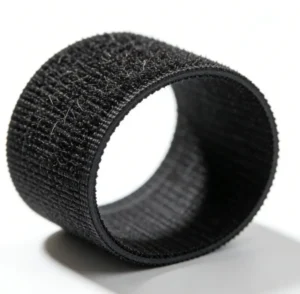
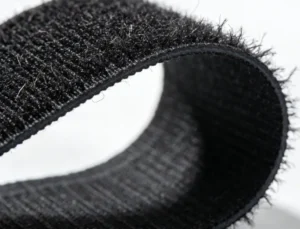
2. Weaving Process Issues (Loose Construction)
Low weaving density or insufficient stitch count — the tape lacks structural integrity and edge firmness.
Unstable warp and weft tension — causes uneven surface and inevitable edge fraying after slitting.
Poor mold precision for hook or loop formation — leads to irregular fiber protrusion at edges.
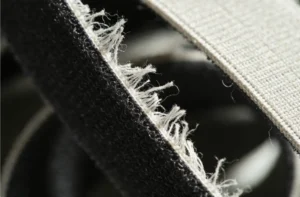
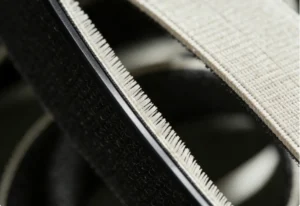
3. Cutting / Slitting Process (Most Common Cause)
Dull blades — fibers are torn instead of cleanly cut, directly causing fraying.
Slitting machine speed too high or unstable pressure rollers — vibration causes uneven and fuzzy edges.
Cold cutting without heat sealing — polyester and nylon will naturally fray when cut cold.
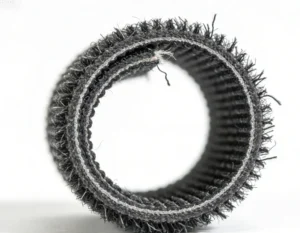
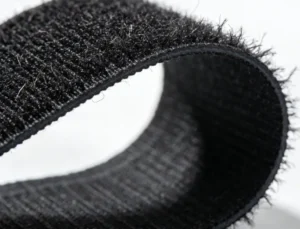
4. Insufficient Post-Processing
No heat cutting, ultrasonic cutting, edge sealing, or thermal setting applied.
Edge fibers are not fused or stabilized, so they fray easily under minor friction.
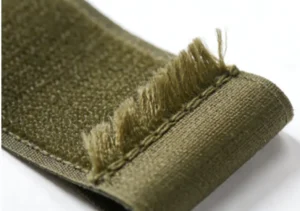
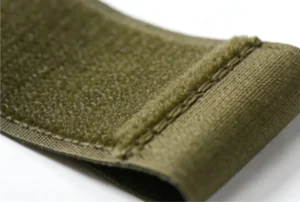
5. Usage and Environmental Factors
Long-term pulling, friction, or washing leads to fiber fatigue and edge deterioration.
High temperature or prolonged UV exposure makes the material brittle, causing powdering or fuzzing at edges.
II. Quick Diagnosis Guide
Frays immediately after tearing, with many loose fine fibers
→ Poor raw materials or loose weaving density
Rough cut edges with stretched fibers
→ Dull blade or cold cutting process
Fraying occurs only after long-term use
→ Normal wear or insufficient abrasion resistance
III. Practical Solutions to Prevent Fraying
1. Use heat cutting or ultrasonic cutting — edge fusion is the most effective solution.
2. Replace blades regularly and ensure they remain sharp.
3. Select high-density woven hook and loop made from virgin materials.
4. Request edge binding, overlock stitching, or thermal setting treatment.
5. For high-end applications, consider injection-molded hooks or ultra-thin anti-fray versions.
If you tell me the specific application (footwear, luggage, medical, home textile, industrial, etc.), I can recommend:
The appropriate material (nylon, polyester, blended)
Recommended density level
Proper cutting method
Complete anti-fray solution tailored to your industry
Let me know your application scenario.


