 info@yousantape.com
 +86-19168575370
 English
 Arabic
 Bengali
 Chinese (Simplified)
 Dutch
Dutch French
 German
 Hindi
Hindi Indonesian
 Italian
 Portuguese
 Russian
 Spanish
 Thai
Thai Vietnamese


In the world of adhesives, the name 3M is synonymous with quality. From automotive manufacturing to mobile phone repairs, from home fixtures to DIY crafts, 3M double-sided tape has won the trust of countless users with its strong adhesion, excellent weather resistance, and stable performance.
But because of its fame, there are more and more fakes on the market. Many people buy what they think is “3M” only to find it doesn’t stick well, leaves black residue, or even melts under high heat. It’s not just a waste of money—if something fails because of bad tape, it can be a safety hazard.
Actually, telling real 3M from fake isn’t as hard as you might think. Once you know a few key tricks, the truth is immediately obvious. Today, I’m sharing all the tips I’ve gathered over the years—pure, practical knowledge.
Tip 1: Check if the Release Liner Sheds Paper Dust
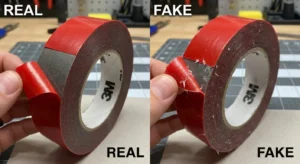
The most direct test is to simply peel off the release liner.
When you peel the liner from genuine 3M double-sided tape, it comes off smoothly, and the peeled-off paper is completely clean—not a single speck of white paper dust. This is because genuine release liner has a high-quality release coating applied. The adhesion between the coating and the adhesive is precisely controlled—it’s easy to peel, but doesn’t transfer any fibers to the glue.
Fake tape is different. To save costs, manufacturers use low-quality release liner with an uneven release coating. When you peel it, it sheds dust. The peeled-off paper is often covered in white, fuzzy paper debris.
Don’t underestimate this detail. It directly reflects the manufacturing quality of the release liner —something counterfeiters struggle most to imitate.
Tip 2: Test for Residue on Your Skin
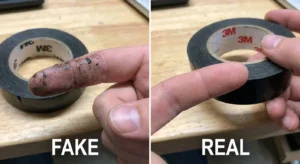
Test for Residue on Your Skin
This trick is even simpler: stick a piece of tape to your hand, then peel it off.
When you peel off genuine 3M tape, your skin is clean. You might feel a slight tackiness, but there will be absolutely no black, sticky residue left behind. This is because genuine 3M tape, especially acrylic-based ones, has high cohesive strength. “Cohesive strength” means the glue molecules hold tightly to each other. When this strength is high, the glue won’t split—it won’t leave on your skin and on the tape.
Fake tape fails this test. After peeling it off, your finger is often covered in black, gooey residue that’s hard to rub off. This happens because the fake adhesive has low cohesive strength—it falls apart when peeled, leaving residue behind.
This test does waste a small piece of tape, but it’s the most way to check adhesive quality.
Tip 3:Burn It and Watch the Smoke
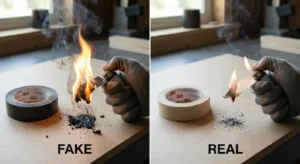
This is the most interesting and test—use a lighter.
Take a small piece of tape and light it with a lighter. Genuine 3M tape burns with a small flame and almost no black smoke. What’s left is grayish-white ash that crumbles finely between your fingers. This is because genuine 3M uses high-purity adhesives and materials that burn relatively completely.
Fake tape burns completely differently. It catches fire easily, producing a large flame and thick, black smoke. The residue is hard, black lumps that break into coarse powder. This is because fakes are loaded with cheap fillers and impurities that don’t burn cleanly.
This test is a bit destructive, but the results are immediate. Fakes can’t hide from this one.
Tip 4: Look for a Clear Batch Number Inside the Core
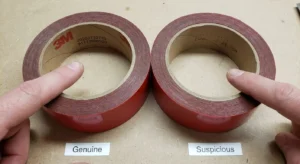
For this trick, stand the tape roll upright and look at the cardboard core in the middle.
On genuine 3M double-sided tape, the inner wall or end face of the core will always have a clear “3M” logo and a batch number printed on it. This batch number isn’t random; each set of numbers corresponds to specific production time and line information. It’s like the tape’s ID card.
What’s on a fake tape’s core? Either it’s completely blank, or it has some random numbers printed in a crooked font. Some fakes are trickier—they deliberately print “M3” or “MM” to fool people. If you’re not looking carefully, you might miss it.
This detail is too costly for counterfeiters to replicate properly. Imitating 3M’s batch numbering system is nearly impossible, so most fakes either leave it blank or print random numbers as decoration.
Tip 5: Inspect the Printing Quality on the Packaging
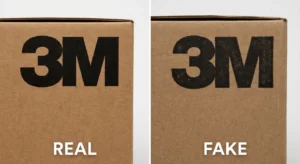
This last tip looks at the first line of defense—the outer packaging.
Genuine 3M packaging, whether it’s the outer carton or the inner wrapping, has very fine printing. The black logo and text are as sharp as a knife cut, with absolutely no blurring or ghosting.
Fake packaging has poor print quality. The edges of the letters are rough, and sometimes even the “3M” lettering itself is printed crooked. The carton material is also flimsy—press on it and you’ll leave a dent. The cardboard looks gray and dull, clearly made from recycled materials.
Of course, some high-quality fakes these days put more effort into packaging, so it’s best to use this tip together with the previous ones for verification.
Final Word: The Right Channel Is Your Ultimate Defense
After sharing all these identification tips, here’s the honest truth: For the average user, the easiest way to avoid trouble is to find the right purchasing channel.
You can check the official 3M website for lists of authorized distributors in different regions. Authorized stores might be a bit more expensive than some online shops, but that extra cost buys you peace of mind. Especially when you’re using tape for critical applications—like in cars, electronics, or hanging heavy items at home—that price difference is insurance.
Because tape might seem insignificant, but when it fails at the wrong moment, the consequences can be serious.
I hope today’s sharing has been helpful. If you’ve ever bought a fake before, or if you have your own unique identification tips, feel free to leave a comment below. Let’s help each other avoid the pitfalls!


