 info@yousantape.com
 +86-19168575370
 English
 Arabic
 Bengali
 Chinese (Simplified)
 Dutch
Dutch French
 German
 Hindi
Hindi Indonesian
 Italian
 Portuguese
 Russian
 Spanish
 Thai
Thai Vietnamese


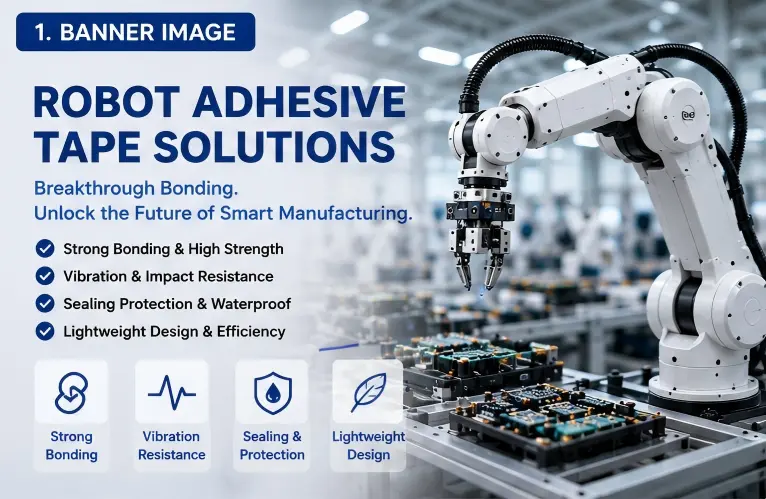
The global robotics industry is evolving rapidly.
From industrial robotic arms on factory production lines to autonomous service robots and next-generation humanoid robots, manufacturers are facing increasingly complex engineering challenges.
Among these challenges, one often-overlooked technology plays a critical role:
robot adhesive tape solutions.
While motors, AI systems, and sensors attract most attention, advanced adhesive tape technologies quietly enable:
– Structural bonding
– Lightweight assembly
– Vibration control
– Waterproof sealing
– Thermal management
– Precision electronic fixation
Without high-performance adhesive solutions, many modern robotic systems simply would not function reliably.
Robot Adhesive Tape Applications in Smart Manufacturing
Why Robot Adhesive Tape Matters in Robotics Engineering
Traditional joining methods such as screws, welding, and liquid adhesives present limitations for modern robotics manufacturing.
Problems with Conventional Assembly Methods
Mechanical Fasteners
– Add unnecessary weight
– Create stress concentration points
– Limit compact structural design
Welding
– Risks thermal deformation
– Damages sensitive substrates
– Increases manufacturing complexity
Conventional Adhesives
– Long curing times
– Poor automation compatibility
– Limited vibration resistance
This is why manufacturers increasingly adopt robot adhesive tape solutions for robotic assembly.
The Core Challenges of Robotics Bonding Applications
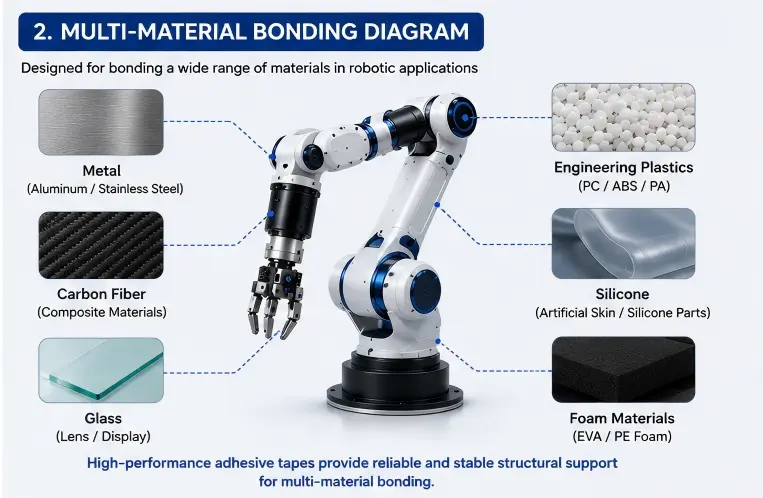
1. Multi-Material Bonding Complexity
Robots integrate diverse materials including:
– Aluminum alloy
– Stainless steel
– Carbon fiber composites
– ABS / PC engineering plastics
– Silicone elastomers
– Glass display panels
Each material has unique surface energy properties.
A high-quality industrial robot bonding tape must deliver reliable adhesion across dissimilar substrates.
2. Extreme Operating Environments
Robotic systems often face harsh conditions:
Industrial Robots
– Continuous vibration
– Oil exposure
– Elevated temperatures
Outdoor Service Robots
– UV exposure
– Moisture
– Dust intrusion
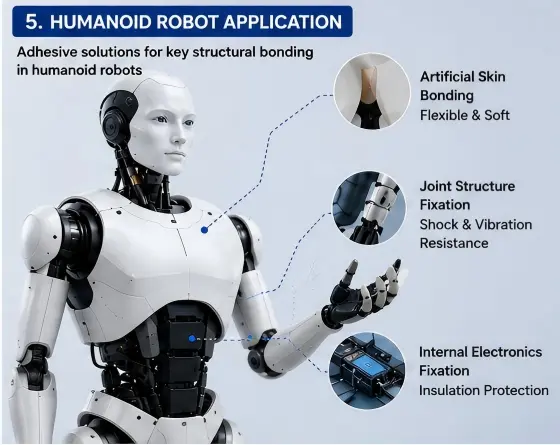
Humanoid Robots
– Dynamic repetitive movement
– Flexible skin deformation
– High-cycle mechanical stress
This demands highly durable robotics adhesive solutions.
3. Precision Automation Requirements
Modern robotic production lines require:
– Automated tape placement
– High-speed die-cut precision
– Bubble-free application
– Curve and contour adaptability
Standard tapes often fail under automated robotic manufacturing conditions.
Essential Performance Requirements for Robot Adhesive Tape
High Structural Strength
Robot structural assemblies demand:
– High shear resistance
– Strong peel adhesion
– Long-term creep resistance
Acrylic foam tapes are often ideal.
Vibration Damping
Industrial robots generate constant mechanical oscillation.
Robot adhesive tape must absorb:
– Repetitive motion stress
– Shock impact
– Dynamic fatigue loading
Thermal Stability
Robotic electronics generate significant heat.
Adhesive systems must withstand:
– Continuous high temperatures
– Thermal cycling
– Battery heat transfer
Waterproof Sealing
Many robotics applications require:
– IP67 waterproofing
– Dust resistance
– Environmental sealing
Closed-cell foam adhesive tape provides excellent protection.
Robot Adhesive Tape Applications Across Robotics Systems
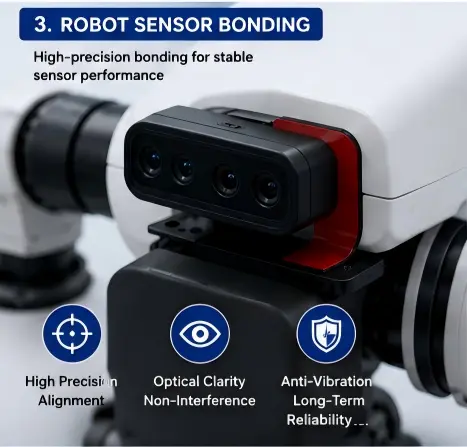
1. Sensor and Camera Module Bonding
Applications:
– Machine vision cameras
– LiDAR modules
– Sensor fixation
Recommended solutions:
– PET double-sided tape
– Optical clear adhesive tape
– Precision transfer adhesive
Benefits:
– Low shrinkage
– Stable optical alignment
– Residue-free performance
2. Structural Bonding for Robot Frames
Used in:
– Outer shell assembly
– Joint reinforcement
– Lightweight panel mounting
Recommended:
Acrylic foam robot adhesive tape
Advantages:
– Strong structural support
– Lightweight replacement for screws
– Excellent vibration absorption
3. Flexible Component Assembly
Humanoid robots require flexible bonding solutions.
Applications include:
– Silicone skin attachment
– Flexible PCB fixation
– Soft robotic actuators
Recommended:
– Silicone adhesive tape
– Flexible acrylic transfer tape
4. Battery Pack Protection and Sealing
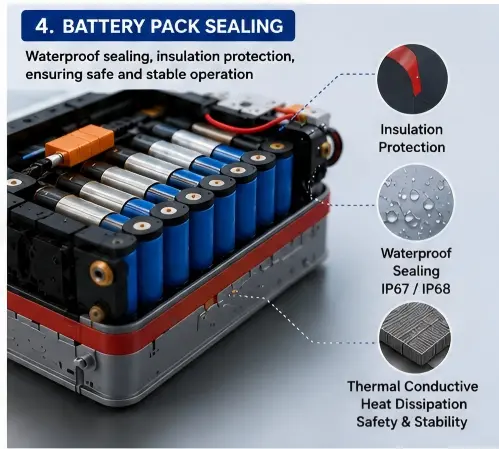
Battery systems require:
– Electrical insulation
– Flame retardancy
– Waterproof sealing
– Thermal resistance
Recommended products:
– Polyimide tape
– Thermal conductive tape
– Closed-cell foam sealing tape
Best Adhesive Tape Types for Robotics Manufacturing
Best for:
– Structural bonding
– Shock absorption
– Lightweight assembly
—
Best for:
– Precision electronics
– Sensor fixation
– Automated die-cut applications
—
Best for:
– Flexible robotic surfaces
– High-temperature applications
—
Best for:
– Heat dissipation
– Battery pack cooling
– Electronic thermal control
—
Emerging Trends in Robot Adhesive Technology
Lightweight Robotics Design
Adhesive bonding supports:
– Reduced robot mass
– Lower energy consumption
– Increased mobility
—
Smart Adhesive Systems
Future robot adhesive tapes may include:
– Self-monitoring capability
– Environmental response adaptation
– Predictive maintenance functions
—
Sustainable Robotics Manufacturing
The future of robot adhesive tape solutions includes:
– Solvent-free systems
– Low-VOC materials
– Recyclable adhesive technologies
—
Why Choose Yousan for Robot Adhesive Tape Solutions?
Yousan provides engineered adhesive solutions for advanced robotics manufacturing.
Our capabilities include:
Certified Manufacturing
– IATF 16949
– ISO 9001
– Precision die-cut production
Custom Robotics Adhesive Engineering
We support:
– Industrial robots
– Service robots
– Humanoid robotics
– AGV systems
– Battery pack assembly
—
Frequently Asked Questions
What is the best adhesive tape for industrial robots?
Acrylic foam tape is widely preferred for structural robotic bonding due to vibration resistance and strong long-term adhesion.
—
Can adhesive tape replace screws in robot assembly?
Yes. High-performance structural adhesive tapes can replace screws in many robotic assemblies while reducing weight and improving design flexibility.
—
What tape is suitable for humanoid robot flexible skin?
Silicone adhesive tape is ideal because it offers flexibility and compatibility with elastomeric materials.
—
Is robot adhesive tape heat resistant?
Yes. Advanced robotics adhesive tapes can withstand continuous temperatures up to 150°C or higher depending on the substrate.
—
Final Thoughts
As robotics moves toward greater intelligence, lighter structures, and more compact designs, robot adhesive tape is becoming a critical enabling technology.
The future of smart manufacturing depends not only on AI and automation—but also on the invisible materials that hold everything together.
Selecting the right **robotics adhesive solution** directly impacts:
– Product lifespan
– Structural reliability
– Manufacturing efficiency
– Long-term safety
—
Contact Yousan for Robotics Adhesive Solutions
Looking for custom robot adhesive tape solutions?
Contact our engineering team for:
✓ Free technical consultation
✓ Sample evaluation
✓ Custom die-cut design
✓ Robotics bonding optimization
Website: www.yousantape.com
Email: info@yousantape.com


