 info@yousantape.com
 +86-19168575370
 English
 Arabic
 Bengali
 Chinese (Simplified)
 Dutch
Dutch French
 German
 Hindi
Hindi Indonesian
 Italian
 Portuguese
 Russian
 Spanish
 Thai
Thai Vietnamese


PET Inline Coating Guide: Process, Coating Types, Applications & Troubleshooting
Introduction
Polyethylene terephthalate (PET) film stands as one of the most versatile polymer substrates in modern industry. Renowned for its exceptional mechanical strength, superior optical clarity, outstanding chemical resistance, and excellent dimensional stability, PET film has become indispensable across packaging, electronics, optical displays, solar energy, and flexible device sectors. However, the raw PET surface often lacks the specific functional properties required for advanced applications — this is precisely where inline coating technology plays a transformative role.
Inline coating, applied during the biaxial orientation process, is the most efficient and cost-effective method to endow PET film with tailored surface functionalities. This comprehensive guide walks through the fundamental principles, process workflow, coating chemistries, critical parameters, application scenarios, and troubleshooting strategies associated with PET inline coating, providing a practical and authoritative technical reference for engineers, researchers, and manufacturing professionals.
1. What Is PET Inline Coating?
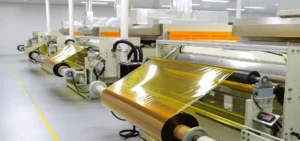
PET inline coating refers to the process of applying a functional coating directly onto the PET film surface during the biaxial stretching production sequence — specifically in the gap after Machine Direction Orientation (MDO) and before Transverse Direction Orientation (TDO).
At this stage, the film has already been stretched longitudinally (typically 3–4×) but has not yet undergone lateral stretching. The coating solution is applied to this intermediate “semi-finished” film, which then enters the TDO oven where the coating simultaneously dries, cures, and is physically embedded into the substrate as the film stretches an additional 3–5× in the transverse direction.
This unique integration creates an exceptionally strong bond between the coating layer and the PET base film — a bond that is virtually impossible to achieve through post-process (offline) coating methods.
Inline Coating vs. Offline Coating: A Detailed Comparison
| Comparison Item | Inline Coating | Offline Coating |
|---|---|---|
| Coating Timing | During stretching process (after MDO, before TDO) | After film production as a separate process |
| Coating Thickness | Ultra-thin (dry film typically 0.02–0.1 μm) | Thicker (1–10 μm or more) |
| Coating Solution Type | Primarily water-based systems | Both water-based and solvent-based |
| Adhesion to Substrate | Excellent (TDO stretching embeds coating into substrate) | Moderate (relies on surface adhesion forces) |
| Production Efficiency | High (synchronized with film production line) | Requires additional processing steps |
| Equipment Investment | Integrated into existing film production line | Requires independent coating line |
Functional Capabilities of Inline Coating
By employing different coating formulations — such as polyester dispersions, polyurethane dispersions, acrylic emulsions, and silica sol solutions — inline coating can deliver a remarkably diverse range of surface functionalities:
- Adhesion promotion (primer/tie layers for subsequent processing)
- Antistatic properties (surface resistivity reduction)
- Anti-fog performance (hydrophilic surface modification)
- Anti-blocking / slip enhancement (surface micro-roughness control)
- Barrier improvement (moisture and gas resistance)
- Hardcoat base layers (scratch resistance foundation)
- Wettability modification (ink and adhesive receptivity)
2. Inline Coating Process Workflow
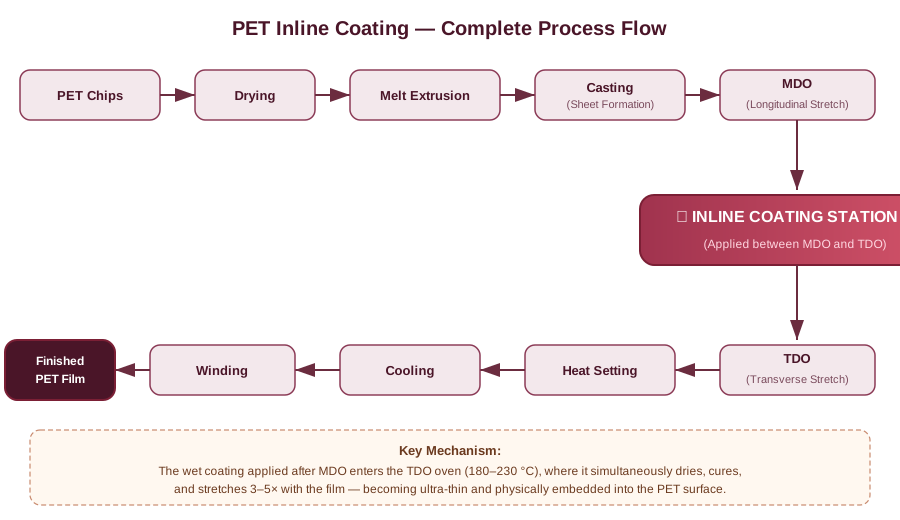
The inline coating step is seamlessly integrated into the standard BOPET (Biaxially Oriented PET) production line. Understanding the complete flow is essential for appreciating how this technology functions.
The Critical Mechanism
The key to inline coating’s success lies in the synergy between coating application and transverse stretching. When the coating solution is applied after MDO, it exists as a wet film on a semi-oriented substrate. As the film enters the TDO stretching oven at 180–230°C, three simultaneous transformations occur:
- Solvent evaporation — the water carrier rapidly evaporates in the high-temperature zone
- Coating curing — polymer chains in the coating cross-link and solidify
- Mechanical embedding — as the film stretches 3–5× transversely, the coating is stretched proportionally, becoming ultra-thin and physically interlocked with the crystallizing PET matrix
This triple mechanism produces coatings with adhesion levels unattainable by any offline method, typically requiring destructive force to delaminate.
3. Common Coating Solution Systems
Selecting the right coating chemistry is critical to achieving the desired functionality. Below are the four major coating solution systems used in PET inline coating, each with distinct characteristics.
3.1 Polyester-Based Coating Solutions
- Composition: Water-dispersible polyester resins (often sulfonated or co-polyester variants for water solubility)
- Key Properties: Excellent transparency, outstanding compatibility with PET substrate due to chemical similarity
- Primary Applications: Adhesion-promoting primer layers; general-purpose tie coats for printing inks, adhesives, and metallization
- Advantages: Exceptional optical clarity (haze increase < 0.3%), strong interlayer bonding
- Typical Solid Content: 2–6%
3.2 Polyurethane-Based Coating Solutions
- Composition: Aqueous polyurethane dispersions (PUDs), often based on aliphatic isocyanates for UV stability
- Key Properties: High flexibility and elongation tolerance, excellent abrasion resistance, superior adhesion to diverse substrates
- Primary Applications: High-adhesion primer coats for demanding printing applications, lamination base coats, flexible electronics substrates
- Advantages: Maintains coating integrity even under severe mechanical deformation
- Typical Solid Content: 3–8%
3.3 Acrylic-Based Coating Solutions
- Composition: Acrylic emulsions or copolymer dispersions (often methyl methacrylate or butyl acrylate based)
- Key Properties: High surface hardness, excellent weather resistance, good chemical resistance
- Primary Applications: Antistatic coatings (when combined with conductive agents), anti-fog coatings (with hydrophilic modification), hard-coat primer layers
- Advantages: Versatile modification capability; easily combined with functional additives
- Typical Solid Content: 2–8%
3.4 Silica Sol Systems
- Composition: Nano-scale silicon dioxide (SiO₂) dispersions, particle size typically 10–100 nm
- Key Properties: Creates controlled surface micro-roughness, improves slip coefficient and anti-blocking performance
- Primary Applications: Anti-blocking treatment for BOPET optical films, slip enhancement for high-speed converting processes
- Advantages: Minimal impact on optical properties when properly formulated; particle size can be tuned for specific COF targets
- Typical Solid Content: 1–5%
3.5 Hybrid and Emerging Systems
Beyond the four classical systems, the industry is increasingly adopting hybrid formulations that combine multiple chemistries:
- Polyester-acrylic hybrids — balancing adhesion with hardness
- Polyurethane-silica composites — combining flexibility with anti-blocking properties
- Nano-functional coatings — incorporating nano-TiO₂ (photocatalytic), nano-ZnO (UV-blocking), or graphene oxide (barrier enhancement)
- Bio-based coating systems — emerging sustainable alternatives using plant-derived polyols and natural polymer dispersions
4. Critical Process Parameters for Inline Coating
Achieving consistent, high-quality inline coatings demands precise control over multiple interrelated parameters.
4.1 Coating Solution Concentration
| Parameter | Typical Range | Notes |
|---|---|---|
| Solid content | 1%–10% | Most commercial formulations operate at 3–6% |
- Too high concentration: Non-uniform coating, streak formation, coating rod contamination, and excessive thickness variation
- Too low concentration: Insufficient functional performance, poor coverage, and inadequate adhesion promotion
- The optimal concentration must be determined through systematic trial runs considering line speed, coating method, and target dry film thickness
4.2 Coating Weight
- Wet coating weight: typically 2–10 g/m²
- Final dry film thickness: 0.02–0.1 μm (after TDO stretching)
- Precise coating weight control is the single most important quality factor in inline coating
- Variation in coating weight directly affects optical properties (haze, transmission), adhesion performance, and surface functionality
- Modern production lines employ real-time monitoring systems (beta-gauge or near-infrared) to track coating uniformity
4.3 Coating Methods
Different coating applicator technologies offer distinct advantages:
Reverse Micro-Gravure Coating:
- Uses an engraved roller rotating against the web direction
- Highest precision among inline coating methods
- Excellent for ultra-thin, uniform coatings
- Gravure cell volume determines coating weight
Meyer Bar (Wire-Wound Rod) Coating:
- A wire-wound rod meters the coating solution
- Simple structure, easy maintenance
- Good uniformity for moderate viscosity solutions
- Wire diameter selection controls coating thickness
Air Knife Coating:
- Uses a focused air jet to remove excess coating
- Best suited for low-viscosity systems
- Provides good cross-web uniformity
- Less precise than gravure methods but highly adaptable
Slot Die Coating (Emerging):
- Pre-metered coating delivery through a precision slot
- Excellent thickness uniformity and minimal waste
- Increasingly adopted in high-end optical film production lines
- Requires precise fluid supply systems
4.4 Drying Conditions
The coating’s drying and curing process is inherently coupled with the TDO stretching operation, which presents both advantages and constraints:
- Primary drying occurs in the TDO preheat zone (typically 90–120°C)
- Final curing takes place at TDO stretching temperatures (180–230°C)
- Excessively rapid drying (preheat temperature too high) → surface skinning, trapped moisture, coating cracking
- Insufficient drying (preheat temperature too low) → wet coating entering the stretching zone, coating defects, roll contamination
- The temperature ramp profile in the TDO preheat section must be carefully optimized for each coating formulation
4.5 Additional Critical Parameters
Beyond the four core parameters, several other factors significantly impact coating quality:
- Web tension control: Affects coating uniformity and film flatness during application
- Coating solution temperature: Influences viscosity and wetting behavior (typically maintained at 20–30°C)
- Ambient humidity at coating station: Excessive humidity can cause premature drying issues
- Filtration level: Coating solutions should be filtered to ≤1 μm to prevent defects
- Solution freshness: Aging or contamination of coating solutions degrades performance
| Comparison Item | Inline Coating | Offline Coating |
|---|---|---|
| Coating Timing | During stretching (after MDO, before TDO) | After film production as a separate process |
| Coating Thickness | Ultra-thin (dry film 0.02–0.1 μm) | Thicker (1–10 μm or more) |
| Coating Solution Type | Primarily water-based systems | Both water-based and solvent-based |
| Adhesion to Substrate | Excellent (TDO stretching embeds coating into substrate) | Moderate (relies on surface adhesion forces) |
| Production Efficiency | High (synchronized with film line) | Requires additional processing steps |
| Equipment Investment | Integrated into existing production line | Requires independent coating line |
5. Typical Application Scenarios
PET inline coating technology serves as the enabling foundation for numerous high-value applications across diverse industries.
5.1 Optical Base Film
Application: LCD/OLED backlight module optical PET films (brightness enhancement films, diffuser films, prism films)
Inline coating provides the essential primer layer that enables subsequent functional coatings (hard coat, anti-glare, anti-reflection) to bond securely to the PET substrate. Without this primer, delamination under thermal cycling would be inevitable. Requirements include **ultra-low haze (< 0.5%)**, high transmission (> 91%), and defect-free surfaces.
5.2 Solar Cell Backsheet Film
Application: PET backsheet films for photovoltaic modules
The inline coating delivers UV-resistant and hydrolysis-resistant protective layers that extend the operational lifetime of solar modules beyond 25 years. Multi-layer inline coating configurations (dual-side coating) are increasingly common to provide both adhesion and weathering functions simultaneously.
5.3 Flexible Electronics
Application: Flexible display substrates, foldable device base films, flexible printed circuit board (FPCB) substrates
Inline-coated PET serves as the base platform for transparent conductive oxide (ITO/IZO) deposition, requiring exceptional surface smoothness (Ra < 1 nm after coating), precise thickness uniformity, and thermal dimensional stability.
5.4 Food Packaging
Application: Barrier packaging, heat-seal lidding films, retort-grade pouches
Inline coatings can provide enhanced oxygen/moisture barrier properties, heat-seal functionality, and anti-fog performance for fresh produce packaging. Water-based PVDC alternative coatings are gaining traction as sustainable barrier solutions.
5.5 New Energy Battery Components
Application: Lithium-ion battery separator surface modification, battery pouch film coatings
Inline-coated PET films with ceramic particle-loaded coatings improve thermal stability and electrolyte wettability of battery separators, contributing to enhanced safety and cycle life performance.
5.6 Release and Transfer Films
Application: Process films for ceramic capacitor (MLCC) manufacturing, mold release films
Ultra-precise inline silicone or fluoropolymer-modified coatings create controlled release surfaces essential for the production of ultra-thin ceramic green sheets used in electronic components.
6. Common Problems and Solutions
Even with optimized processes, inline coating operations can encounter various defects. The following table summarizes the most frequently observed issues, their root causes, and proven corrective actions.
| Problem | Possible Cause | Solution |
|---|---|---|
| Uneven coating | Poor dispersion of coating solution; agglomerates or settling | Enhance stirring intensity; increase filtration precision (use ≤1 μm filters); check dispersion stability |
| Coating delamination | Incompatibility between coating solution and PET substrate | Reformulate coating chemistry; verify substrate surface energy; consider corona pre-treatment adjustment |
| Surface streaks | Coating roller surface defects (scratches, wear, contamination) | Replace or refurbish the coating roller; inspect and clean doctor blade system |
| Coating whitening | TDO temperature excessively high causing coating crystallization or phase separation | Reduce preheat zone temperature; adjust temperature ramp profile; modify coating formulation |
| Coating blistering | High dissolved air content in coating solution | Implement vacuum deaeration treatment; reduce agitation speed before application; use defoaming agents |
| Orange peel texture | Surface tension mismatch; inadequate wetting | Add surfactant/wetting agent to formulation; verify coating solution viscosity |
| Edge build-up | Improper coating width control or edge bead formation | Adjust edge masking; optimize coating roller engagement pressure |
| Haze increase | Excessive coating thickness or particle agglomeration | Reduce solid content; improve particle dispersion; verify coating weight calibration |
Preventive Quality Control Recommendations
To minimize defect occurrence, leading manufacturers implement the following best practices:
- Incoming material inspection — verify every batch of coating solution for viscosity, pH, particle size distribution, and solid content
- Regular roller maintenance — gravure rollers should be inspected and re-chromed on a defined schedule
- Environmental control — maintain cleanroom-grade conditions (Class 10,000 or better) at the coating station
- Real-time monitoring — deploy inline inspection systems (camera-based and optical sensors) for immediate defect detection
- Statistical process control (SPC) — track coating weight, haze, and adhesion data to identify trends before they become problems
7. Future Trends in PET Inline Coating Technology
The PET inline coating field continues to evolve rapidly, driven by escalating performance demands and sustainability requirements:
- Multi-layer inline coating — applying two or more functional layers in a single pass through tandem coating stations
- Nano-engineered coatings — incorporating nanoparticles for enhanced barrier, conductivity, or self-cleaning properties
- Sustainable formulations — transitioning to bio-based and VOC-free coating systems aligned with circular economy principles
- Digital coating control — AI-driven process optimization using real-time sensor data for autonomous parameter adjustment
- Ultra-high-speed lines — adapting coating technologies for next-generation BOPET lines operating at 500+ m/min
- Functional integration — combining multiple properties (e.g., antistatic + anti-blocking + adhesion promotion) in a single coating layer
8. Conclusion
PET inline coating technology represents one of the most efficient, economical, and high-performance approaches to functionalizing polyester film. Its core advantage — the seamless integration with the biaxial stretching process — delivers unparalleled coating adhesion, ultra-thin uniformity, and production efficiency that offline methods simply cannot match.
As demand for high-performance PET films continues to accelerate across optical displays, renewable energy, flexible electronics, advanced packaging, and electric vehicle components, inline coating technology will increasingly serve as the critical enabling process that transforms commodity PET into high-value functional materials.
For engineers and manufacturers, mastering the interplay between coating chemistry, application method, and TDO process conditions remains the key to unlocking the full potential of this versatile technology.


